Corangamite Shire · Wadawurrung Country
Skipton
A wool town on Mount Emu Creek, where the Glenelg Highway crosses it and the rail trail from Ballarat ends. 609 people at the last census, and the platypus. Its story from the record, and what is here today.
Fig. 1
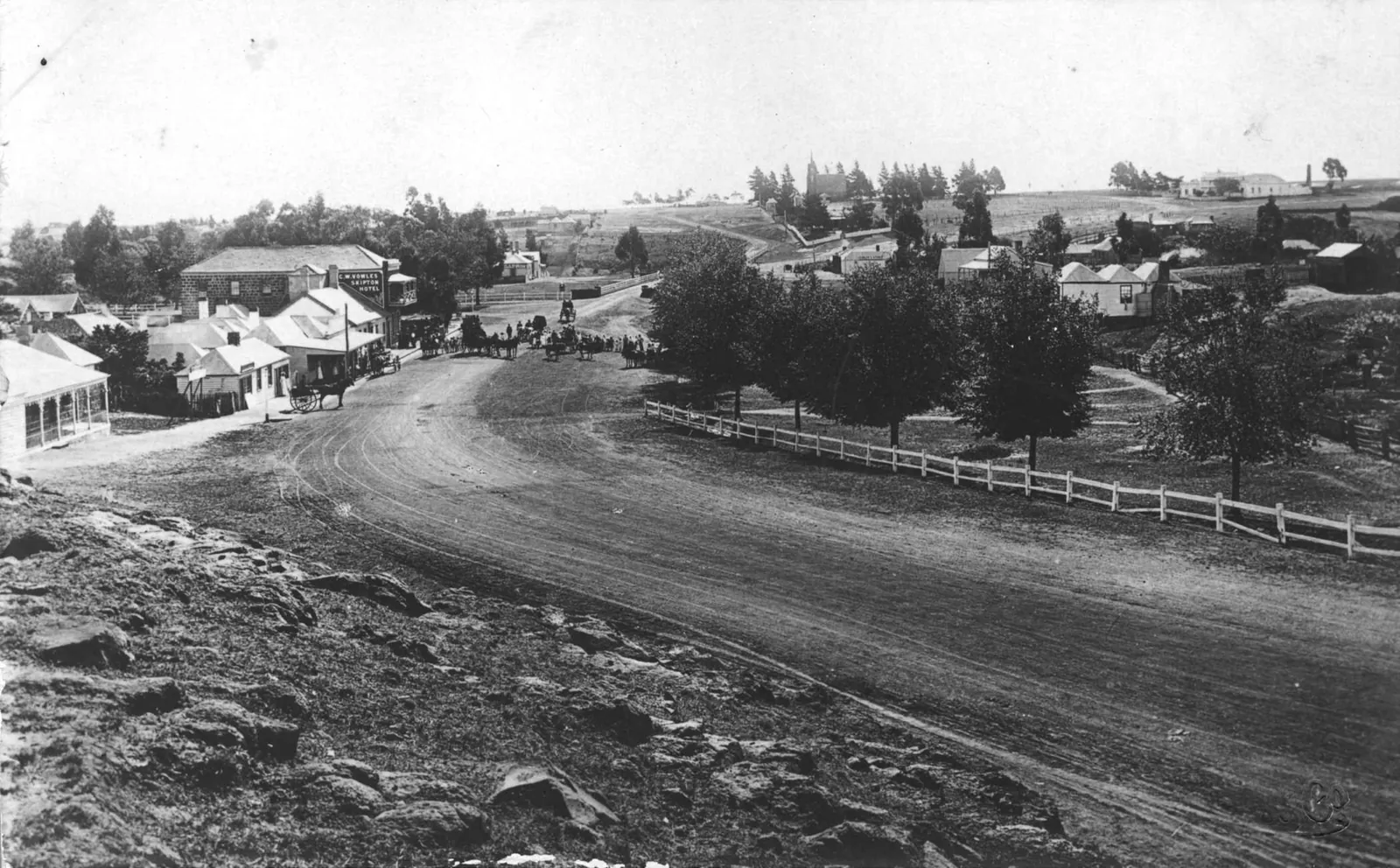
Sheep town
From the public record: the newspapers on Trove, the heritage listings, the Australian Dictionary of Biography, the Department of Education’s school history. Where the sources disagree, the page says so. The year beside each part is the year it turns on. G. C. Notman’s Out of the Past (1939), written for the town’s centenary, and the district’s other histories are not online and were not read; this page is no substitute for them.
Before 1838
Wadawurrung Country
Skipton is on Wadawurrung Country, inside the area of the Wadawurrung Traditional Owners Aboriginal Corporation, its Registered Aboriginal Party. In the Corporation’s own words: “We acknowledge that our Ancestors nurtured and cared for Wadawurrung Country for tens of thousands of years.”
No Wadawurrung name for the town or the creek was found in anything the Corporation has published. A colonial surveyor’s list gives words for the hills and the creek here; they are not the Corporation’s, and this page does not print them. Anything more is theirs to say.
From Wadawurrung Traditional Owners Aboriginal Corporation and the Victorian Aboriginal Heritage Council, Wadawurrung Traditional Owners Aboriginal Corporation.
1839
The run on Emu Creek
Sheep came first. A run was taken up here in 1838 by one account and 1839 by another, and the town keeps 1839: it held its centenary in 1939, and a cairn in Stewart Park marks the year. As it was told in 1937, William Wright, James Montgomery and Alexander Anderson took up a run they called Bamgamie, “their first homestead … just where Skipton stands, the woolshed being on the site of the police station.”
In 1845 the partners fell out. Anderson kept the land west of the creek and called it Baangal; Wright and Montgomery went upstream, and in 1853 sold out to William Mitchell, whose station was Langi Willi. The novelist Henry Kingsley stayed at Langi Willi in the 1850s, and in 1883 Rolf Boldrewood wrote that Geoffrey Hamlyn was written there. The Australian Dictionary of Biography gives Kingsley only house-room.
On the plan: 1, The 1839 cairn.
From Victorian Places, Skipton, the Victorian Heritage Database, Mooramong (H2442), the Australasian, 7 August 1937, Rolf Boldrewood in the Australasian, 24 March 1883, the Australian Dictionary of Biography, Henry Kingsley and Visit Great Ocean Road, Stewart Park.
1852
At Wright and Montgomery’s station
The first town lots were sold at Geelong in April 1852, “Skipton … parish Skipton, at Emu Creek”, and that August the Government Gazette fixed a village at “Skip-ton, at Wright and Montgomery’s station, on the Emu Creek.” Who chose the name is not recorded. It is thought to be after Skipton in Yorkshire, whose Old English name means sheep town, and at the centenary the mother town sent a telegram.
By 1855 the Eagle Inn stood beside “Wright and Montgomery’s bridge” on the road from Geelong to Portland Bay; it burnt down in April 1857. The Skipton Hotel was open by March 1858. In 1860 the Star’s correspondent found Skipton “remarkable for nothing in particular”: about thirty houses, a small brick church, a stone pub and a wooden one, a post office “where anything may be bought” and two blacksmiths. Then he gave the town its answer: “you should see us in the shearing season”, with both hotels “filled with drunken shearers, shearing more sheep in those bars than they ever did in the shed”.
On the plan: 2, The bridge.
From the Argus, 21 April 1852, the Argus, 5 August 1852, Victorian Places, Skipton, the Age, 10 April 1939, the Geelong Advertiser, 25 September 1855, the Star, 30 April 1857, the Argus, 2 July 1858 and the Star, 23 August 1860.
1858
The minister and the school
The Presbyterians had trustees for a church site by July 1857, and called a minister, the Rev. T. M’Aulis. In January 1858 he was leading two horses when they bolted; their tethers caught round him and he was dragged nearly a mile, and he died the next day. “The reverend gentleman who was much respected retained his senses to the last.”
The church opened a school on 1 January 1858, by the Department of Education’s record, with Ebenezer Blair and 22 pupils. It closed in 1864 for want of money, and that October opened again in a bluestone common school that the district had built, with 59 on the roll. (Victorian Places dates the school from 1864.) Before any of it, an old resident remembered, Mrs Parsons gathered the township’s children, and the punishment was the pantry, where they ate the jam.
In 1888 the school moved to a red-brick building “on a high and well-drained position” on the east side of town. It is School No. 582, and it is there still.
On the plan: 3, School No. 582.
Fig. 2
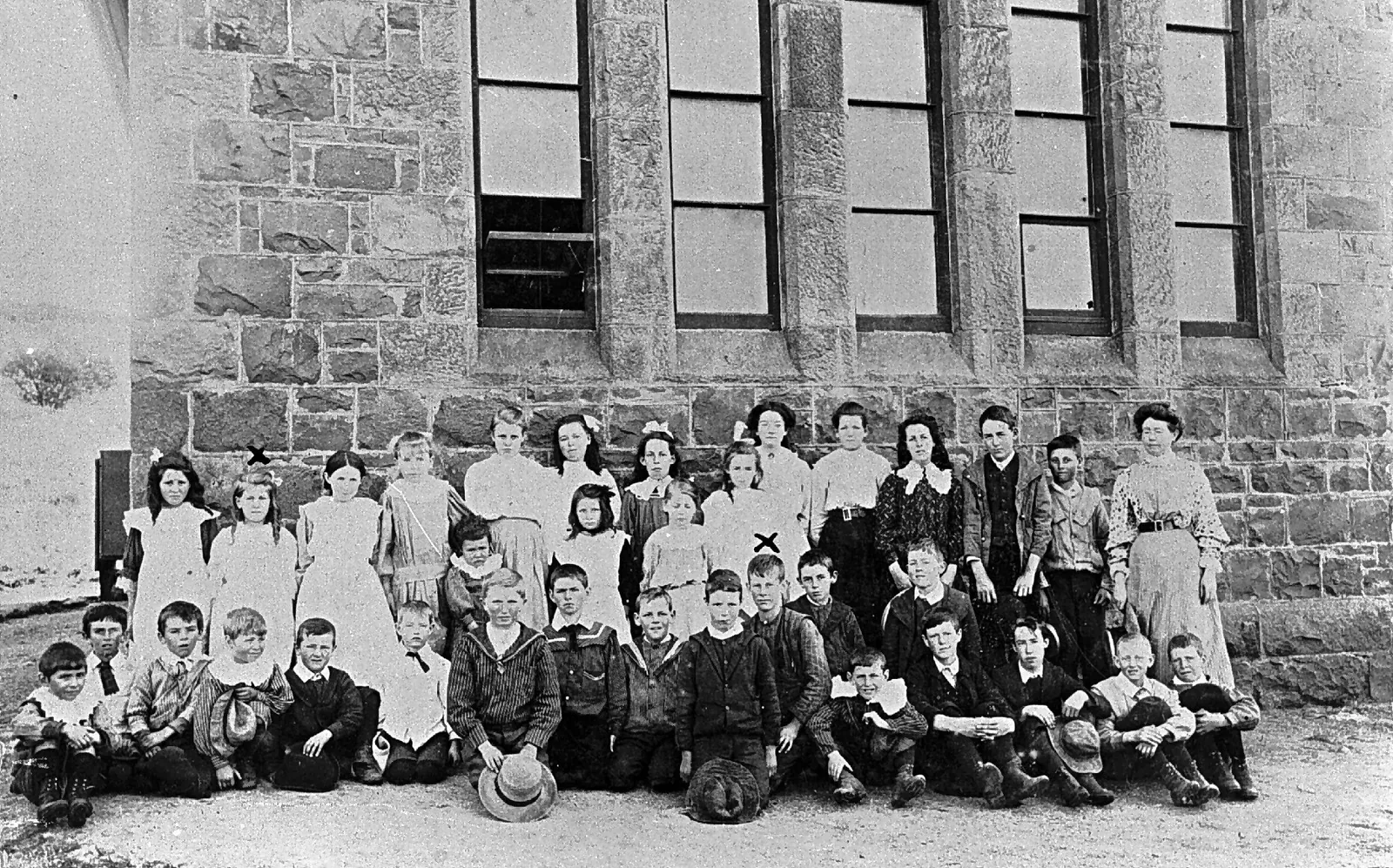
Children and their teacher outside the old common school. The catalogue says about 1885; the clothes look nearer 1900. Museums Victoria, MM 1403 From the Age, 30 July 1857, the Age, 22 August 1857, the Argus, 13 January 1858, the Department of Education, Skipton Primary School No. 582, the Star, 26 November 1864, the Skipton Standard, 19 June 1915, the Camperdown Chronicle, 27 June 1888 and Victorian Places, Skipton.
1859
The Skipton show
On 6 April 1859, with Francis Ormond in the chair, the new society at Skipton adopted its rules and changed its name to the Western District Agricultural Society, “it being considered that the word Skipton made it too local”. The first races were run the next day, and the first show on 7 September. (The Australian Dictionary of Biography has Ormond helping to found an association at Skipton in 1855.)
For fifteen years Skipton’s shows and ram sales “drew breeders and buyers from all parts of Australia and New Zealand”, as the Australasian remembered in 1930, and the sheep sold there stocked the Riverina and Queensland. At the 1860 show J. L. Currie’s 426 two-tooth rams went at £3 14s to £4 15s each. The shows ran until 1873 or so, and then the main show went to Ballarat.
Fig. 3
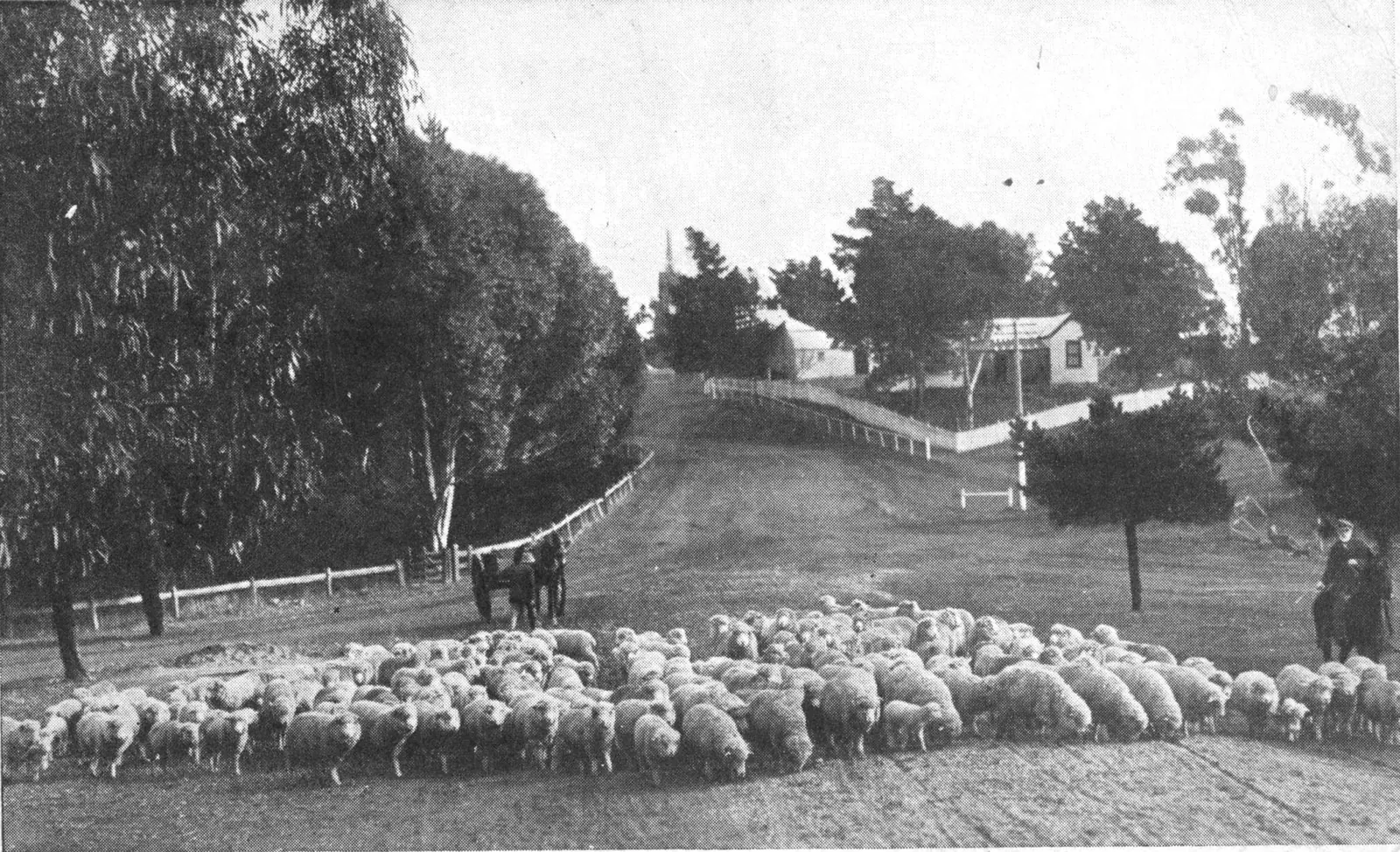
“A flock on its way to market”, as the Weekly Times captioned it in August 1918. The State Library dates its postcard of it about 1923. State Library Victoria, H96.200/1447 From the Geelong Advertiser, 12 April 1859, the Star, 14 September 1859, the Australian Dictionary of Biography, Francis Ormond, the Australian Dictionary of Biography, Thomas Shaw junior, Bell’s Life in Victoria, 16 April 1859, the Argus, 21 September 1860, the Australasian, 30 August 1930, Victorian Places, Skipton and the Weekly Times, 24 August 1918.
1870
Show day under water
The show of 8 September 1870 drowned. Alexander Anderson had sent word to the town to get ready; by eleven the water was two or three feet deep round the Skipton Hotel, and by afternoon it was higher than anyone had seen it, and one side of the creek was cut off from the other. Senior-constable Hurley rode in and saved the government books, then tried to bring Mr and Mrs Allan out of their stone cottage. They would not leave, and he had to be dragged ashore on a rope.
Forty-five years on, an old resident remembered Whitpaine’s hotel laid for a hundred at a guinea a head, people “floating in and out of doors on rafts, improvised from tables upturned”, and a youth who made £4 15s ferrying people across in a dray at half a crown each. “This was about the death-blow to the grand old Skipton Show.”
The creek has come up again and again. In 1909 the town’s traffic went by boat. In January 2011 the gauge read 6.04 metres, the largest flood on record: the shops at the low end of Montgomery Street and thirty houses went under, and the town was split in two. Which flood was the biggest nobody can say, because 1909 was never measured. Since 2022 a mural on the highway bridge has been the town’s informal gauge.
On the plan: 2, The bridge.
From the Ballarat Star, 12 September 1870, the Argus, 10 September 1870, the Skipton Standard, 24 April 1915, the Skipton Standard, 1 May 1915, the Portland Guardian, 23 August 1909 and VICSES, Skipton Local Flood Guide.
1872
St Andrew’s
On 13 December 1871 Alexander Anderson laid the foundation stone of a bluestone church with a silver trowel, to plans by Davidson and Henderson of Geelong: Gothic, fifty feet by thirty-four, with a spire of eighty feet. It opened on 15 September 1872, “one of the handsomest churches to be met with in the country districts of these colonies”, with carved gargoyles where the gables meet the spire. The heritage register asks, in brackets, whether they are kangaroos.
Beside it the Russell Hall, a Sunday school built with £1,000 left by George Russell of Langi Willi because the old one “was getting out of repair, and it was also in the flood area”, opened on 20 May 1918. The church’s honour board went up the next year, and there are Sunday services still.
On the plan: 4, St Andrew’s and the Russell Hall.
Fig. 4
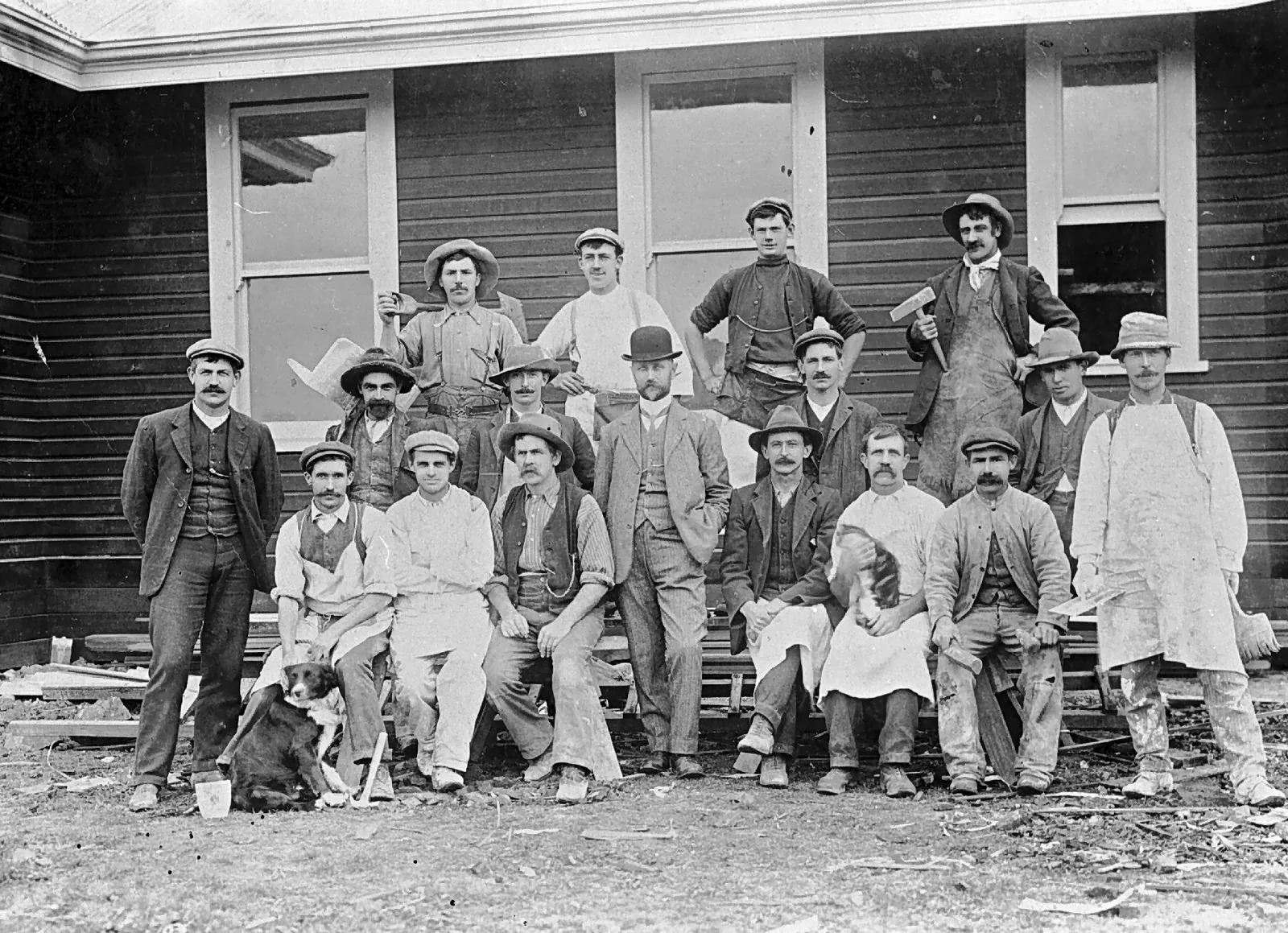
“Builders outside Russell Hall”, 1918: the men who built the Sunday school hall, with a collie and a cat. Museums Victoria, MM 1402 From the Geelong Advertiser, 16 December 1871, the Ballarat Star, 20 September 1872, the Victorian Heritage Database, St Andrew’s Presbyterian Church (H0484), the Skipton Standard, 25 May 1918 and the Skipton Standard, 18 October 1919.
1874
The men who shore it
This was merino country. In 1880 Borriyalloak held the Goldsbrough Gold Cup for the most valuable bale of washed wool in the colonies, and its rams had fetched 200 guineas a head; Mooramong’s flock came from the Ercildoune sheep Anderson bought about 1854. In 1920 Miss E. Earles won the Skipton Standard’s essay prize with “I believe that no finer wool is produced anywhere than in the water shed of our ‘silver stream’—the Emu Creek.”
The shearers came on foot. A. J. Sullivan ran away from home near Ballarat at sixteen, and in 1874 he and his younger brother signed on as learners at Baangal, A. M. Gardiner’s, at fourteen shillings a hundred. “We soon found we were ‘messers’ and not shearers.” Gardiner told them he was so delighted with their work “that we need not come near his place again, adding slyly that if we did he would send for the police.” Sullivan wrote it down in 1922, after twenty-five years of lecturing, on Dickens among others, with “not a semblance of an education”.
At the 2021 Census sheep farming was still what more people in the district worked at than anything else.
Fig. 5
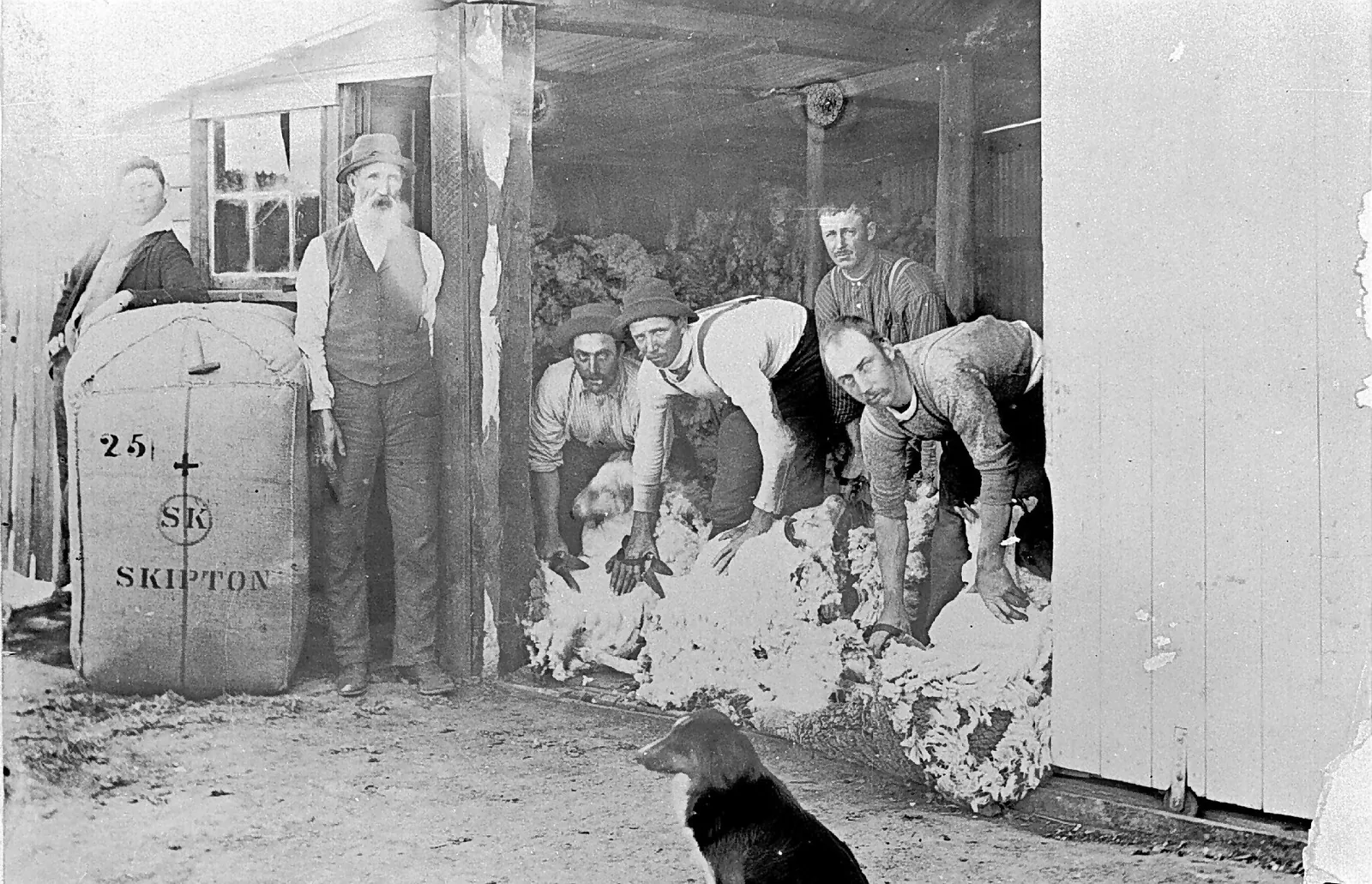
Shearing with blades in a woolshed doorway, before 1900. The bale is stencilled SKIPTON. The catalogue names S. Knight and James Francis among them, without saying which. Animated by AI from the photograph; the movement is ours, not the archive’s. Museums Victoria, MM 1658 From the Leader, 14 August 1880, the Skipton Standard, 10 January 1920, A. J. Sullivan in the Skipton Standard, 24 June 1922, the Skipton Standard, 1 July 1922 and ABS 2021 Census QuickStats, Skipton.
1877
Two shires and a bridge
Mount Emu Creek was a boundary: from 1863 until the 1990s Ripon Shire had the west bank and Hampden the east, and the town had a Ripon side and a Hampden side. In March 1873 the townspeople met Anderson behind the brass band, took the horses out of his carriage and pulled it into town themselves, and read him an address as “the founder of Skipton”. In August 1877 the two shires opened a new bridge of bluestone and Mount Cole timber on the site of the first, of 1847, and Anderson broke a bottle of champagne on the centre pier. The councillors lunched at the Skipton Hotel “amidst a terrific dust storm”.
The court house came from the Fiery Creek diggings at Beaufort, where it had stood in the Government camp since 1856; it was moved here in 1867, by the heritage register, which counts it one of the very few portable buildings left from the gold rush. (Victorian Places dates it 1857.) The court closed on 1 January 1983, and the Historical Society keeps it now, by the police stables of 1890 in Stewart Park. The Mechanics’ Institute opened on the creek bank in December 1880.
On the plan: 2, The bridge; 5, The court house; 6, The Mechanics’ Hall.
Fig. 6
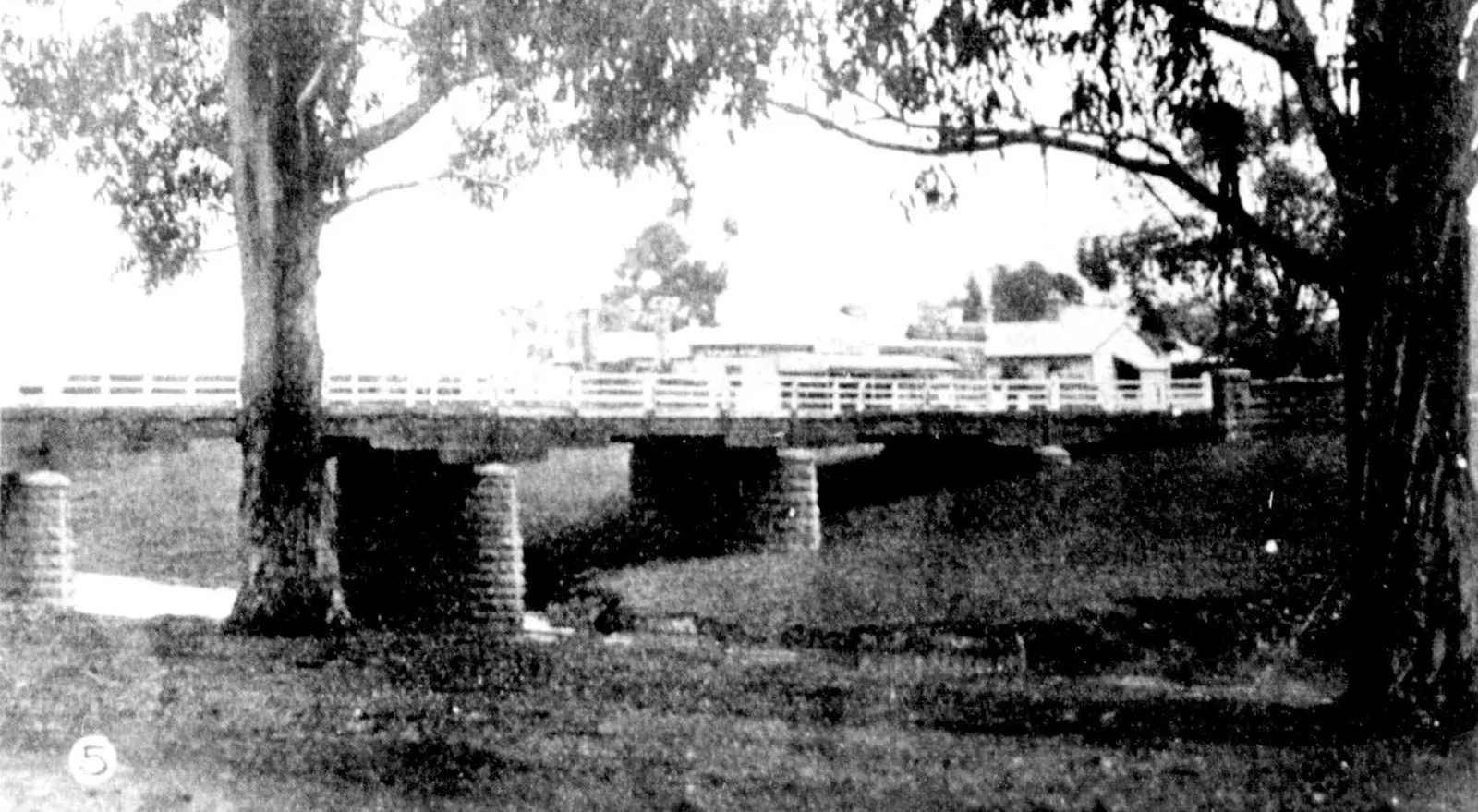
“Bridge over Emu Creek, Skipton”, 1918: timber on round stone piers. The paper does not say whether it is the bridge of 1877. The Weekly Times, 24 August 1918, via Trove From Victorian Places, Ripon Shire, Victorian Places, Hampden Shire, the Ballarat Star, 8 March 1873, the Geelong Advertiser, 20 August 1877, the Victorian Heritage Database, Skipton Court House (H1485), Victorian Places, Skipton, the Auditor-General, Court Closures in Victoria (1986), Visit Great Ocean Road, Stewart Park and the Ballarat Star, 24 December 1880.
1887
V.R. in pines
The trees were the town’s own doing. The water reserve was planted first, and in 1886 the schoolchildren and their friends planted the elms along Montgomery Street. For the Queen’s jubilee in 1887 the reserve was extended, and the children of Skipton and Spring Hill planted pines ten feet apart in the letters and figures “V.R.—1887”, the trees the gift of Robert Chirnside of Carranballac. On 2 February 1894 the Governor, Lord Hopetoun, opened it as the Royal Jubilee Park.
The Ripon side planted its own main street the next year, “but through neglect only one of the 17 trees survived”. In 1901 the Ripon council fenced and planted Stewart Park, over “the old quarry holes and ragged appearance” at that end of town. (The visitor guide says the park was made in the 1980s from the police paddocks.)
On the plan: 7, Jubilee Park.
From the Skipton Standard, 17 April 1915, the Argus, 3 February 1894, the Ballarat Star, 3 February 1894 and Visit Great Ocean Road, Stewart Park.
1916
The railway
In 1911 a parliamentary committee heard that carters were so scarce at harvest that teams had come from Port Fairy, at up to 1s 4d a bag, and that farmers were turning more and more to sheep. The bill passed in 1912. Choosing the station site, the minister tried to keep off the recreation reserve, which the Hampden council “fought hard” to keep.
The first train ran over the line on Monday 17 January 1916, and the minister opened it the next day. “Skipton was en fete”; the schoolchildren had a free trip to Linton, and for some “it was the first experience … of having a ride in a railway carriage”. A Linton writer had said only two farmers would use it. The Skipton Standard suggested that “only two Skipton farmers might be carting their grain to Linton.” (Victorian Places dates the line from 1918.)
By 1932 one train a week ran beyond Linton, and by 1939, the Age said, the passenger trains had stopped; other accounts have them, or a school train, into the 1970s. The line closed on 4 December 1986. It is the Ballarat–Skipton Rail Trail now, 54 kilometres back through Linton, Scarsdale and Smythesdale, and it ends at the station site.
On the plan: 8, The station site; 9, The recreation reserve.
From the Ballarat Star, 12 June 1911, the Skipton Standard, 20 February 1915, the Evening Echo, 17 January 1916, the Evening Echo, 18 January 1916, the Skipton Standard, 22 January 1916, VicSig, the Skipton line, Victorian Places, Skipton, the Argus, 18 October 1932, the Age, 20 July 1939 and Rail Trails Australia, Ballarat–Skipton Rail Trail.
1918
The avenue
Frank Holford Williams of Banongill, who had been to school in Skipton, was killed at Gallipoli on 7 August 1915, aged eighteen years and seven months, and the flags at the Mechanics’ Hall and the school flew at half-mast. William John Angus, a carpenter, was wounded at Passchendaele and died at Boulogne the next day, 14 October 1917, aged twenty. His family gave a chair to the Presbyterian church in his memory.
On 31 August 1918 the town planted an avenue of honour: 156 elms on the road to Streatham, each tree-guard with a soldier’s name, a flag and a twig of wattle, and wreaths on the guards of the dead, “and many a tear was shed”. Eleven more went in that September. The war heritage inventory counts 169 trees and a new avenue planted about 2000; where the old one stood is not recorded.
In 1925 Lord Stradbroke opened a bush nursing hospital, built for £2,000 as the district’s memorial to its soldiers. The war memorial in Anderson Street carries a roll of the soldier settlers who took up estates here after the Second World War.
On the plan: 10, The war memorial.
Fig. 7
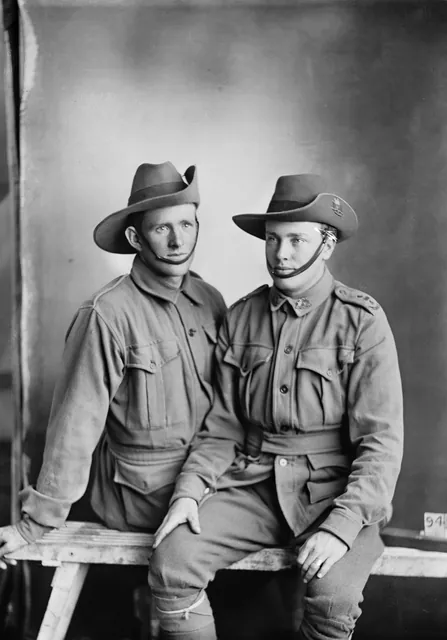
Privates William John Angus (left) and Archibald Madden, of the 5th Battalion and the Skipton district, at Broadmeadows camp about May 1915. Madden came home wounded in 1918. Australian War Memorial, DA09432 From the Skipton Standard, 11 September 1915, the Australian War Memorial, DA09432, the Skipton Standard, 7 September 1918, the Skipton Standard, 14 September 1918, the Victorian War Heritage Inventory, Skipton Avenue of Honour, the Herald, 21 November 1925 and the Victorian War Heritage Inventory, Skipton War Memorial.
1921
“Pudden”
Henry Bolte was born at Ballarat East in 1908, and his parents moved to Skipton. His childhood was the Ripon Hotel, which his father kept until 1921; the larger Skipton Hotel, which the Boltes bought from the Warrens that year; and the State school, where he topped seventh grade in 1920. He was “Pudden” or “Pud”, for his build, and swam with his friends in the “Big Hole” of Mount Emu Creek.
In the Depression he worked in shearing sheds and joined the AWU. He played cricket and football for Skipton, was “a keen two-bob punter” and the racing club’s secretary, and in 1934 married his neighbour Jill Elder. He became Premier of Victoria in 1955, the longest-serving there has been, and in 1963 came back to open Skipton’s new memorial hospital.
Fig. 8
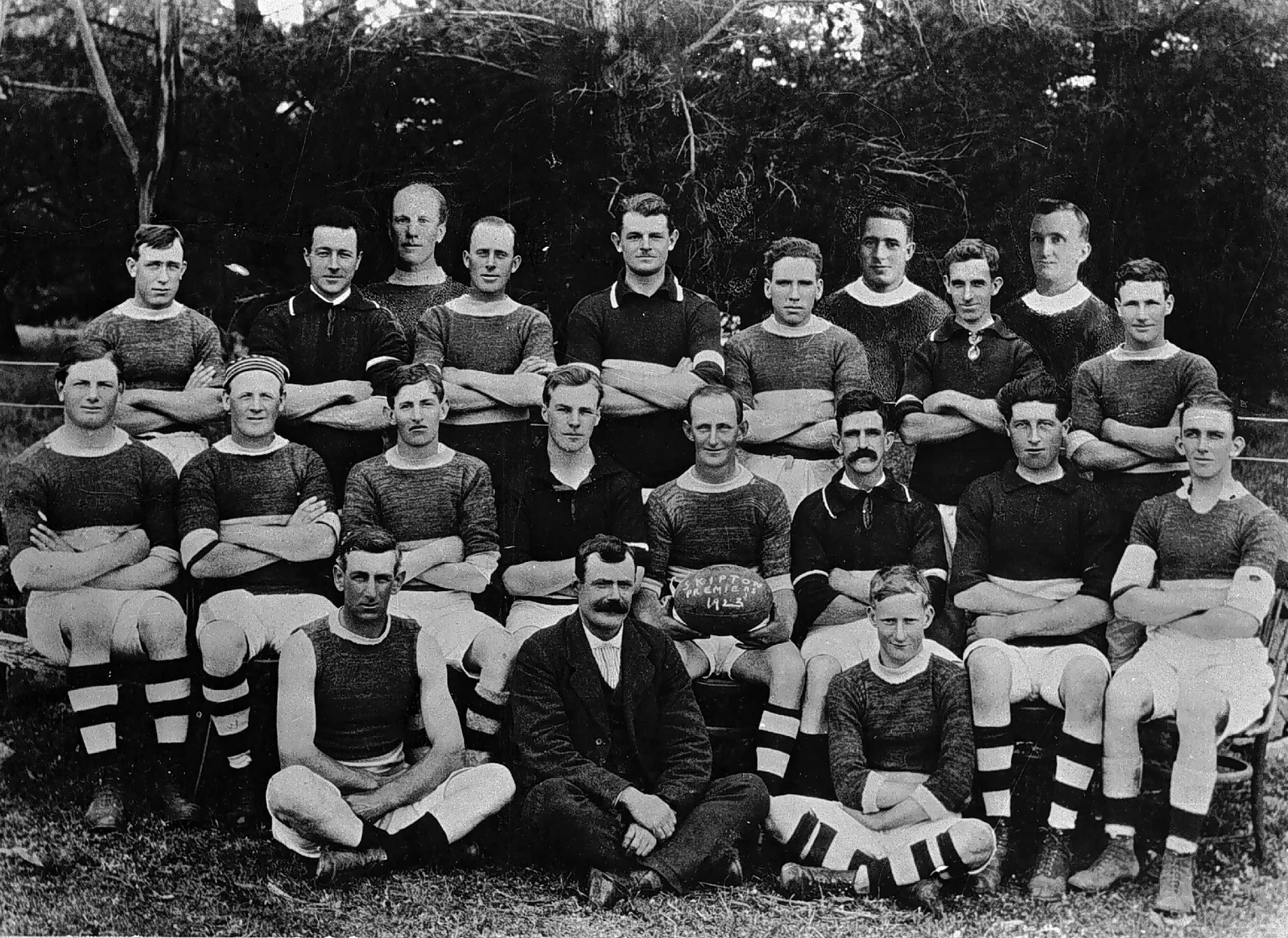
Skipton’s premiers, 1923: the ball is chalked SKIPTON PREMIERS 1923. The players are not named. Bolte, fifteen, was at school in Ballarat by then. Museums Victoria, MM 1401 From the Australian Dictionary of Biography, Sir Henry Bolte, the Department of Education, Skipton Primary School No. 582, the Victorian War Heritage Inventory, Skipton Memorial Hospital and Rail Trails Australia, Ballarat–Skipton Rail Trail.
1938
Mooramong
Anderson kept a third of his run, called it Mooramong, and in 1873 began a timber house on it. It went to the Stodarts in 1889 (the Leader had it in other hands by 1880), and in 1926 or 1928 to Scobie Mackinnon, bought for him by his father. In London in 1937 Scobie met the Canadian silent-film star Claire Adams, Rin Tin Tin’s leading lady in Where the North Begins, and they married three weeks later.
In March 1938 they came to Mooramong and made it “a jazz-age folly with Art Deco cocktail bar, swimming pool, games room, and a bathroom reminiscent of a film star’s dressing-room”; the pool was the first private heated one in Victoria. They were life governors of the Skipton hospital. Scobie died in 1974 and Claire in 1978, and she left the rest of her estate to the National Trust for a wildlife sanctuary at Mooramong. It has been closed since the fire of January 2026, which spared its buildings.
Fig. 9
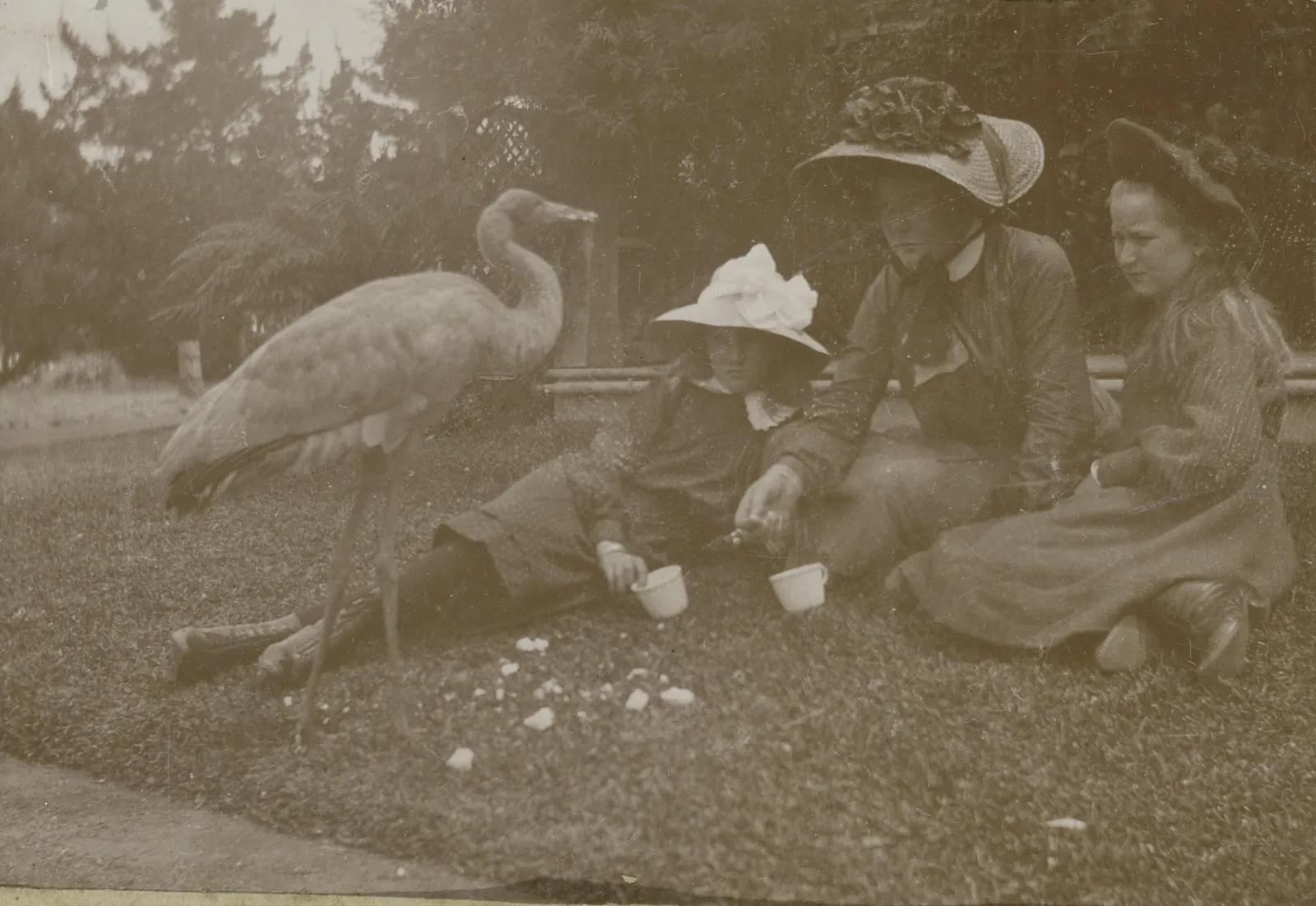
Three girls feeding a tame brolga from teacups on the lawn at Mooramong, 1906, when it was the Stodarts’. The girls are not named. Animated by AI from the photograph; the movement is ours, not the archive’s. University of Queensland, Fryer Library, F3480 From the Victorian Heritage Database, Mooramong (H2442), the Leader, 14 August 1880, the Australian Dictionary of Biography, Scobie Mackinnon and the National Trust, Mooramong.
1940
The platypus
In 1860 there were blackfish and eels in the big waterholes. The eels came up from the Hopkins, and a naturalist who had known the creek nearly thirty years wrote in 1909 that a night’s fishing once always brought a fair take of blackfish, before the carp, tench, perch and trout. In 1940 Ernest Austin of Borriyalloak, forty-nine years on the creek, wrote to the naturalist David Fleay: “In six miles of the creek I should say there are about 20 platypuses, and one generally finds pairs of them in the largest holes.”
There are platypus in the creek still. The platform in Stewart Park, by the highway bridge, looks out over the water.
On the plan: 11, The platypus platform.
From the Star, 23 August 1860, the Australasian, 13 March 1909, the Australasian, 26 October 1940 and Visit Great Ocean Road, Stewart Park.
1944
Fire
On 6 February 1914 a fire from Mawallok, “probably caused by the sun’s rays focussing on a piece of broken glass”, burnt across the country between Skipton, Beaufort and Carngham, and a man died of his burns. On 14 January 1944 Skipton was “practically surrounded by fire”; about 300,000 sheep were lost in its district and the districts round it, and Mooramong lost its shearing shed.
On 9 January 2026, a day of catastrophic fire weather, a grassfire started north of Streatham and ran east on westerly winds of more than 80 km/h, through Carranballac and along the Glenelg Highway, and burnt south of the township: about 20,000 hectares. The first counts of what was lost disagree, from more than ten homes to 59 buildings, eighteen of them houses. The town met in the Mechanics’ Hall, and by the end of March more than 690 people had been to the recovery hub. A book and a documentary about the fire are to be launched at the hall on 24 October 2026.
From the Lismore, Derrinallum and Cressy Advertiser, 11 February 1914, the Argus, 15 January 1944, the Age, 18 January 1944, the Victorian Heritage Database, Mooramong (H2442), the Ararat Incident Control Centre’s community newsletter, 13 January 2026, the Courier, 12 January 2026, the Hepburn Advocate, 13 January 2026, Corangamite Shire, “Bushfire recovery continues across Shire”, 31 March 2026 and Corangamite Shire, Skipton fire 2026.
2021
From thirty houses
Skipton had 121 people at the census of 1861 and barely more than 150 until the 1890s. It had 590 by 1911, and has stayed near five hundred since. In April 1939 it kept its centenary with three arches over the roads, a fancy-dress procession, a ball and a history, G. C. Notman’s Out of the Past; that July the electric light was on its way from Ballarat.
At the 2021 Census 609 people lived in the Skipton locality, which reaches out to Langi Willi and Banongill, and 469 in the town itself. Their median age was 53.
From Victorian Places, Skipton, the Argus, 5 April 1939, the Age, 20 July 1939, ABS 2021 Census QuickStats, Skipton and ABS 2021 Census QuickStats, Skipton (urban centre).
Where it happened
Skipton as it lies now, from OpenStreetMap, with the buildings in grey. Much of what this history names cannot be placed: the Eagle Inn, the first church and schools, the show ground, the avenue of honour. These can.
1. The 1839 cairn. In Stewart Park: most likely the cairn for “the earliest settlement of the Skipton area in 1839”.
2. The bridge. The highway over Mount Emu Creek, with the flood mural on its south-east pylon. The bridges of 1847 and 1877 stood on one site; that it was this one is likely, not recorded.
3. School No. 582. In its red-brick building on the hill since 1888.
4. St Andrew’s and the Russell Hall. The bluestone church of 1872, and the Sunday school hall of 1918 beside it.
5. The court house. Here since 1867 by the heritage record, with the police stables of 1890. The Historical Society’s now.
6. The Mechanics’ Hall. The Institute of 1880 stood on the creek bank; whether this hall is its building is not recorded.
7. Jubilee Park. The water reserve, planted from 1887 and opened as the Royal Jubilee Park in 1894. Where the letters were is not recorded.
8. The station site. 1916 to 1986: the engine-shed ruins, a history board, and the end of the rail trail.
9. The recreation reserve. Kept from the railway in 1915. Its oval is the town’s bushfire place of last resort.
10. The war memorial. 3 Anderson Street, with a roll of the soldier settlers after the Second World War.
11. The platypus platform. On Mount Emu Creek, in Stewart Park.
Skipton now
Checked 9 October 2026. Something missing, closed or wrong? Write to hello@onelobster.au
Skipton Primary School
School · 7 Montgomery Street
Prep to Grade 6. School No. 582, in its red-brick building on the hill since 1888.
Grounds supervised 8.45am–3.35pm
(03) 5340 2002skipton.ps@
education.vic.gov.auskiptonps.vic.edu.au Skipton Kindergarten
Kindergarten · 8 Montgomery Street, across from the school
Three- and four-year-old kinder, and childcare, in one building run by the shire.
0448 481 261skipton.kindergarten@
corangamite.vic.gov.auShire kindergartens Beaufort & Skipton Health Service, Skipton campus
Health · 2 Blake Street
The hospital: an urgent care centre with nurses day and night, six beds, the nursing home, and the Skipton Medical Practice, which bulk bills. For anything life-threatening ring 000.
Urgent care 24 hours · GPs Monday–Friday 9am–5pm (book on 5340 1110)
Skipton Pharmacy
Pharmacy · 17 Montgomery Street
The chemist, beside Country Grocers on the highway.
Monday–Friday 9am–5pm · Saturday 9am–12pm
Skipton Police Station
Police · 22 Blake Street
A one-officer station that is not always open: ring before you go. In an emergency ring 000.
(03) 5340 2001SKIPTON.UNI@
police.vic.gov.aupolice.vic.gov.au Skipton fire station
CFA · Montgomery Street, at the west end of town
The Skipton Fire Brigade’s station, next to the ambulance station. In an emergency ring 000. This is the South West fire district: check it on fire danger days.
Country Grocers Skipton
Store · 15 Montgomery Street
The supermarket, with takeaway liquor. Open every day into the evening.
Every day 8am–7.30pm
(03) 5340 2020skipton@
countrygrocers.com.auskipton.countrygrocers.com.au Skipton Roadhouse and Post Office
Fuel and post office · 40–44 Montgomery Street
Caltex fuel, hot food, groceries and cabins. The town’s post office, with PO boxes and Parcel Collect, is at the same address.
Post office Monday–Friday 8.30am–5pm · Saturday 9am–12pm
Bluestone Bubbles & Banter
Café · 36 Montgomery Street
A licensed café in a bluestone cottage on the highway. Its hours are short at present: check its Facebook page before you go.
Skipton Op Shop
Op shop · 21 Montgomery Street
Run by the Skipton Community Shop, which gives its takings back to the town’s groups as grants. Open every day.
Monday–Friday 10am–4pm · Saturday 10am–3pm · Sunday 10am–2pm
Skipton Mechanics Hall
Hall · 5 Anderson Street
The town hall, about 120 years old, with a supper room, meeting room and kitchen. The library is here, the market fills it on the second Saturday of the month, and bingo is in the supper room on the first Wednesday.
Library Tuesday 10am–12pm, Friday 3–5pm · Market second Saturday 9am–1pm
Skipton Progress Association
Community · Meets at the Mechanics Hall, 5 Anderson Street
Runs the market, the Spring Festival, and bingo and quiz nights, and publishes the Skipton Community News, free to every household in 3361 each week of the school term since 1977.
St Andrew’s Presbyterian Church
Church · 48–50 Montgomery Street
The bluestone church of 1872, still holding Sunday services.
Sunday 9am in even months, 11am in odd months
St John’s Catholic Church
Church · 3 Anderson Street
Part of Holy Trinity Parish, with Linton, Redan, Sebastopol and Snake Valley.
Sunday Mass 10.30am (check the parish notice sheet)
southwestballarat@
ballarat.catholic.org.auballarat.catholic.org.au Christ Church Anglican
Church · Montgomery Street, at the east end of town
Anglican, in the Parish of Beaufort and Skipton. Ring the parish for service times.
Skipton Cemetery
Cemetery · Currie Street, on the western edge of town
Eight acres reserved for the town’s dead in 1861, with a few graves that are older. Kept by the Skipton Cemetery Trust.
Stewart Park and the platypus
Park · Montgomery Street, by the bridge over Mount Emu Creek
Parkland on Mount Emu Creek. Wait quietly on the viewing platform at dawn or dusk for a platypus. The old court house and police buildings are the Historical Society’s museum: ring to visit.
Jubilee Park and the pool
Park · Montgomery Street, through to the pool on Blake Street
The lake, a playground, a barbecue shelter and toilets, a skate park and four tennis courts, with the solar-heated outdoor pool at the far end, open in summer with lifeguards.
Pool, in summer: 11am–7pm weekends and holidays, 2.30–7pm school days
Ballarat–Skipton Rail Trail
Walk and ride · The old station site, at the south end of Anderson Street
The end of the 54 km trail from Ballarat along the old railway. The station site has a trail map, a history board and RV camping by donation. Linton is 20 km back along it.
Skipton Recreation Reserve
Reserve · Smythe Street and Osborne Street
The football oval, netball courts, change rooms and a function room, and the ground for the Spring Festival in November. The oval is Skipton’s Neighbourhood Safer Place, the bushfire place of last resort.
Skipton Football Netball Club
Club · John Peeters Oval, 15 Smythe Street
The Emus: five football and eight netball sides in the Central Highlands league, playing on Saturdays. Senior premiers in 2025.
Skipton Golf & Bowls Club
Club · Geelong Road, on the south-east edge of town
A golf course with grass greens and a synthetic bowling green, and a licensed clubhouse that can be booked for functions.
Mooramong
Heritage · 2851 Carngham–Streatham Road, about 11 km west-north-west
The National Trust’s homestead of Claire Adams and Scobie Mackinnon, with its 1930s rooms and a nature reserve. Closed to visitors since the January 2026 fire, which spared its buildings.
McGregor’s Rural Contracting
Fencing · Based in Skipton
Angus McGregor: steel farm fencing and exclusion fencing, planned and put in, on jobs of a kilometre or more.
To read more
G. C. Notman’s Out of the Past: the story of Skipton 1839–1939 was written for the centenary, and the Progress Association reprinted it in 1978 and 1988. Mary Turner Shaw’s On Mount Emu Creek (1969) is the story of a station here; Barry Nitschke’s The Settlers of Skipton (2001) is the soldier settlers’; Janet Walsh’s Tales from Skipton (2003) and Further Tales from Skipton (2008), and Norman Houghton and Jack McLean’s Cross Country (1986), on the railway, are the rest. This page has read none of them. The State Library holds them, and the Skipton and District Historical Society, in the old court house in Stewart Park, is the place to ask.
Sources
Everything above was read on 9 October 2026. Where two sources disagree, the page says so.
- Wadawurrung Traditional Owners Aboriginal Corporation
- The Victorian Aboriginal Heritage Council, Wadawurrung Traditional Owners Aboriginal Corporation
- Victorian Places, Skipton
- The Victorian Heritage Database, Mooramong (H2442)
- The Australasian, 7 August 1937
- Rolf Boldrewood in the Australasian, 24 March 1883
- The Australian Dictionary of Biography, Henry Kingsley
- Visit Great Ocean Road, Stewart Park
- The Argus, 21 April 1852
- The Argus, 5 August 1852
- The Age, 10 April 1939
- The Geelong Advertiser, 25 September 1855
- The Star, 30 April 1857
- The Argus, 2 July 1858
- The Star, 23 August 1860
- The Age, 30 July 1857
- The Age, 22 August 1857
- The Argus, 13 January 1858
- The Department of Education, Skipton Primary School No. 582
- The Star, 26 November 1864
- The Skipton Standard, 19 June 1915
- The Camperdown Chronicle, 27 June 1888
- The Geelong Advertiser, 12 April 1859
- The Star, 14 September 1859
- The Australian Dictionary of Biography, Francis Ormond
- The Australian Dictionary of Biography, Thomas Shaw junior
- Bell’s Life in Victoria, 16 April 1859
- The Argus, 21 September 1860
- The Australasian, 30 August 1930
- The Weekly Times, 24 August 1918, via Trove
- The Ballarat Star, 12 September 1870
- The Argus, 10 September 1870
- The Skipton Standard, 24 April 1915
- The Skipton Standard, 1 May 1915
- The Portland Guardian, 23 August 1909
- VICSES, Skipton Local Flood Guide
- The Geelong Advertiser, 16 December 1871
- The Ballarat Star, 20 September 1872
- The Victorian Heritage Database, St Andrew’s Presbyterian Church (H0484)
- The Skipton Standard, 25 May 1918
- The Skipton Standard, 18 October 1919
- The Leader, 14 August 1880
- The Skipton Standard, 10 January 1920
- A. J. Sullivan in the Skipton Standard, 24 June 1922
- The Skipton Standard, 1 July 1922
- ABS 2021 Census QuickStats, Skipton
- Victorian Places, Ripon Shire
- Victorian Places, Hampden Shire
- The Ballarat Star, 8 March 1873
- The Geelong Advertiser, 20 August 1877
- The Victorian Heritage Database, Skipton Court House (H1485)
- The Auditor-General, Court Closures in Victoria (1986)
- The Ballarat Star, 24 December 1880
- The Skipton Standard, 17 April 1915
- The Argus, 3 February 1894
- The Ballarat Star, 3 February 1894
- The Ballarat Star, 12 June 1911
- The Skipton Standard, 20 February 1915
- The Evening Echo, 17 January 1916
- The Evening Echo, 18 January 1916
- The Skipton Standard, 22 January 1916
- VicSig, the Skipton line
- The Argus, 18 October 1932
- The Age, 20 July 1939
- Rail Trails Australia, Ballarat–Skipton Rail Trail
- The Skipton Standard, 11 September 1915
- Australian War Memorial, DA09432
- The Skipton Standard, 7 September 1918
- The Skipton Standard, 14 September 1918
- The Victorian War Heritage Inventory, Skipton Avenue of Honour
- The Herald, 21 November 1925
- The Victorian War Heritage Inventory, Skipton War Memorial
- The Australian Dictionary of Biography, Sir Henry Bolte
- The Victorian War Heritage Inventory, Skipton Memorial Hospital
- The Australian Dictionary of Biography, Scobie Mackinnon
- The National Trust, Mooramong
- The Australasian, 13 March 1909
- The Australasian, 26 October 1940
- The Lismore, Derrinallum and Cressy Advertiser, 11 February 1914
- The Argus, 15 January 1944
- The Age, 18 January 1944
- The Ararat Incident Control Centre’s community newsletter, 13 January 2026
- The Courier, 12 January 2026
- The Hepburn Advocate, 13 January 2026
- Corangamite Shire, “Bushfire recovery continues across Shire”, 31 March 2026
- Corangamite Shire, Skipton fire 2026
- The Argus, 5 April 1939
- ABS 2021 Census QuickStats, Skipton (urban centre)
- State Library Victoria, H96.200/1448
- Museums Victoria, MM 1403
- State Library Victoria, H96.200/1447
- Museums Victoria, MM 1402
- Museums Victoria, MM 1658
- Museums Victoria, MM 1401
- University of Queensland, Fryer Library, F3480